
.png)
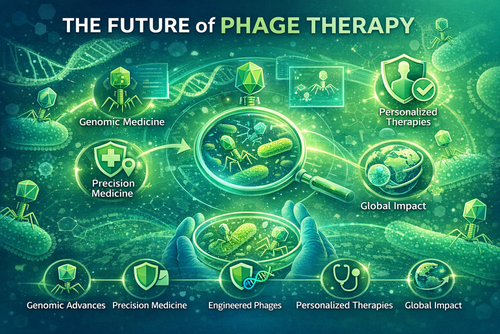
Phage therapy is an innovative medical approach that uses bacteriophages, or simply phages, to treat bacterial infections. Bacteriophages are viruses that specifically infect and kill bacteria while leaving human cells unharmed. Discovered over a century ago, phage therapy is gaining renewed global attention as antibiotic resistance threatens modern healthcare.With multidrug-resistant (MDR) and extensively drug-resistant (XDR) bacteria on the rise, phage therapy offers a targeted, sustainable, and biologically precise alternative to conventional antibiotics.
What Are Bacteriophages?
Bacteriophages are the most abundant biological entities on Earth, found in soil, water, food, and the human microbiome. Each phage is highly specific, usually infecting only one bacterial species or even a specific strain.
How Phages Work
- A phage attaches to a specific bacteriumIt injects its genetic material into the bacterial cell
- The phage hijacks the bacterial machinery to replicate
- The bacterium bursts (lysis), releasing new phages
- This self-amplifying mechanism makes phage therapy particularly effective at the site of infection.
Why Phage Therapy Matters Today
The Antibiotic Resistance Challenge
Antibiotic resistance is one of the top global public health threats, responsible for millions of infections annually. Overuse and misuse of antibiotics in medicine, agriculture, and animal production have accelerated bacterial evolution, rendering many antibiotics ineffective.
Phage therapy addresses this challenge by:
- Targeting bacteria with high specificity
- Remaining effective against antibiotic-resistant strains
- Reducing damage to beneficial microbiota
Key Advantages of Phage Therapy
- Precision Treatment: Unlike broad-spectrum antibiotics, phages attack only the disease-causing bacteria, preserving healthy microbiomes.
- Effectiveness Against Resistant Bacteria: Phages can kill bacteria that are resistant to all known antibiotics.
- Self-Limiting and Self-Amplifying: Phages replicate only in the presence of their target bacteria and naturally decline once the infection is cleared.
- Low Toxicity: Phage therapy has shown minimal side effects in clinical and compassionate-use cases.
- Adaptability: Phages can evolve alongside bacteria, reducing the likelihood of long-term resistance.
Clinical Applications of Phage Therapy
- Phage therapy has shown promise in treating:Chronic wound infections, Diabetic foot ulcers, Burn-related infections, Respiratory tract infections, Gastrointestinal infections, Biofilm-associated infections, Post-surgical and implant-related infections, Phage therapy is also being explored in veterinary medicine, food safety, agriculture, and environmental biocontrol.